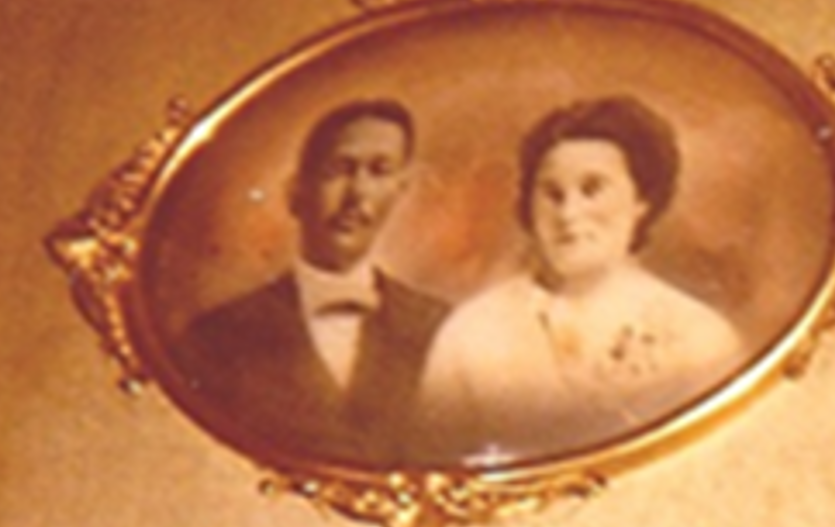
November 16, 1885 – June 27, 1971
Julia Althea Jackson
née Ruffin · wife and widow of Dr. Andrew C. Jackson
A Tulsa educator who survived the 1921 Tulsa Race Massacre, lost her husband to the mob on his own front lawn, and — in the days that followed — turned her own grief outward to help the thousands of Greenwood residents left with nothing. She would rebuild her life in Chicago as a YWCA house director and a founding force behind the South Side Community Art Center, outliving Dr. Jackson by half a century.
From the record
Primary source- Full name
- Julia Althea Ruffin
- Born
- November 16, 1885
- Birthplace
- Calvert, Robertson County, Texas
- Father
- Willie Ruffin
- Mother
- Laurina Gilmore
- Married
- Dr. Andrew C. Jackson (widowed June 1, 1921)
- Later married name
- Julia A. Ferguson
- Died
- June 27, 1971 · Chicago, Illinois
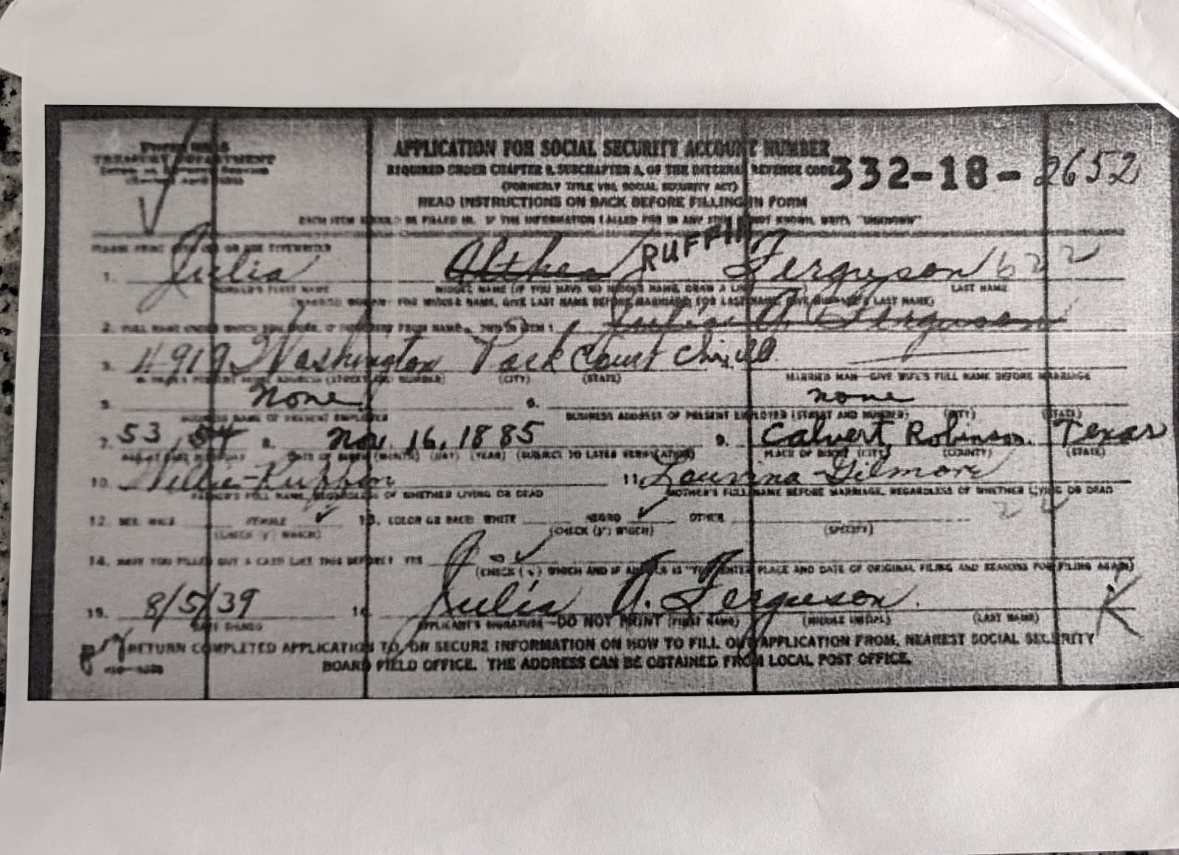
These vitals are drawn from her own 1939 Application for a Social Security Account Number (Form SS-5), reproduced below — a primary-source document that fixes her exact date and place of birth and names both of her parents for the first time in this registry.
Her life
An educator in Greenwood
Julia Althea Ruffin was born on November 16, 1885 in Calvert, Robertson County, Texas, the daughter of Willie Ruffin and Laurina Gilmore. She married Dr. Andrew C. Jackson and joined him in Tulsa's Greenwood district — the thriving Black community the world would come to know as “the Negro Wall Street of America.”
In Greenwood, Julia was an educator in the Tulsa Public Schools. She was part of the district's Black professional society, and the Tulsa Star newspaper documents her moving through that world with a freedom and standing the Jacksons had built: a notice records Mrs. A. C. Jackson departing on an extended trip through Nevada, California, and Oregon, stopping to take in the Panama-Pacific International Exposition in San Francisco. For a Black woman in the America of that era, such a journey was a measure of exactly how much Greenwood had made possible.
The warning
“They're going to kill you”
According to family oral history, as tensions rose Julia pleaded with her husband to leave Tulsa and come with her to Chicago, where they would be safe. She told him plainly: “They're going to kill you.”
Dr. Jackson refused to go. He would not abandon his patients or his community. He sent her on, and he stayed. On June 1, 1921, he walked out of their home on Detroit Avenue with his hands raised in surrender and was shot down on his own front lawn. Julia carried the heartbreak of that refusal for the rest of her life: she had seen the danger, begged him to leave, and lost him because he would not.
Three days later
In charge of the relief house
Julia survived the massacre. Her husband had been murdered, her home and his practice were burned, and like the roughly ten thousand other Greenwood residents left homeless that day, she had lost nearly everything she owned.
And yet — just three days later — a Tulsa newspaper found her not in mourning but at work for everyone else. On June 4, 1921, the Tulsa Tribune reported that the “Y” (the Y.W.C.A.) was erecting a “hostess house” on Archer Street to shelter the hundreds of Black women and girls left homeless, and that two women had been placed in charge of the temporary relief quarters:
“Mrs. Julia Jackson and Mrs. Howard, colored women, are to take charge of the temporary quarters late today and will be actively supervising the work there with a corps of trained assistants from the groups of colored Y.W. workers.”
That is her — “Mrs. Julia Jackson,” still carrying the name of the husband she had buried seventy-two hours earlier — placed in charge of sheltering, feeding, and caring for the survivors of the same massacre that had just taken everything from her. Family history long held that Julia “helped others at the Y” in the days after Dr. Jackson was killed. The contemporaneous record does not merely confirm it; it shows she was running the relief house.
It says as much about who Julia Jackson was as any record could. The same week she was made a widow by the mob, she was found leading the care of the people the mob had left behind. Service to others was not a phase of her grief; as the rest of her life would show, it was simply who she was.
“Hostess House for Negroes Is Being Erected,” Tulsa Tribune, June 4, 1921, p. 6. The relief work was organized through the Y.W.C.A.; the Jackson family's memory of Julia “helping at the Y” is borne out by the paper naming her directly.
1923
Administratrix of his estate
Two years after the massacre, Julia was still at work settling what the mob had left of her husband's affairs. On May 3, 1923, she filed the formal Notice to Creditors for the Estate of Andrew C. Jackson in the County Court of Tulsa County — signing it, in her own changed name, “Julia A. Ferguson-Jackson, Administratrix.” The notice directed creditors to present their claims to her at 101 North Greenwood Street, in the heart of the district that had burned.
The document is quietly telling. By 1923 she had remarried — she is already “Ferguson” — yet she kept “Jackson” in her signature and stood as the legal administrator of the estate of the man she had married and lost. She did not walk away from his name or his affairs; she carried both.
Tulsa Daily Legal News · May 17, 1923
Primary source“In the Matter of the Estate of ANDREW C. JACKSON, Deceased… All persons having claims… are required to present the same… to the undersigned administratrix at 101 North Greenwood Street, Tulsa, Oklahoma… Dated this the 3rd day of May, 1923. JULIA A. FERGUSON-JACKSON, Administratrix.”
View the notice (PDF)Chicago
A founding force in Black art
The woman who rebuilt her life in Chicago did not merely survive — she led. By the late 1930s, Julia Ferguson had placed herself at the center of the South Side's civic and artistic life.
In December 1938, the Chicago Defender photographed her at an exhibition of Black art at the Quincy Club on Michigan Avenue — an event drawing nearly 200 people “interested in the establishment of the South Side Community Art Center.” In the photograph, the painter Eldzier Cortor — who would become one of the most important American artists of the twentieth century — explains his technique, and “Mrs. Thelma Kirkpatrick and Mrs. Julia Ferguson are shown at right.” Julia stands at Cortor's side as the Art Center is being willed into being.
The South Side Community Art Center, founded under the WPA's Federal Art Project, opened in a building at 3831 South Michigan Avenue. It is the only one of the roughly one hundred WPA community art centers still operating today, in its original home. On May 7, 1941, First Lady Eleanor Roosevelt traveled to Chicago to dedicate it, in a ceremony broadcast nationally on CBS Radio.
Family history holds that Julia — a central figure at the Center in exactly the years it was founded and dedicated — met Eleanor Rooseveltduring that period. The dedication and Julia's documented role in the Center's founding are both established in the record; the personal meeting rests on family testimony, and the family continues to search for the article that records it.
Chicago Defender · Dec 10, 1938
Primary source“Artists Display Work at Exhibition” — the exhibition of Black art, attended by nearly 200 people interested in establishing the South Side Community Art Center, where Eldzier Cortor explained his painting and “Mrs. Thelma Kirkpatrick and Mrs. Julia Ferguson are shown at right.”
View the clipping (PDF)A life of service
House director, officer, organizer
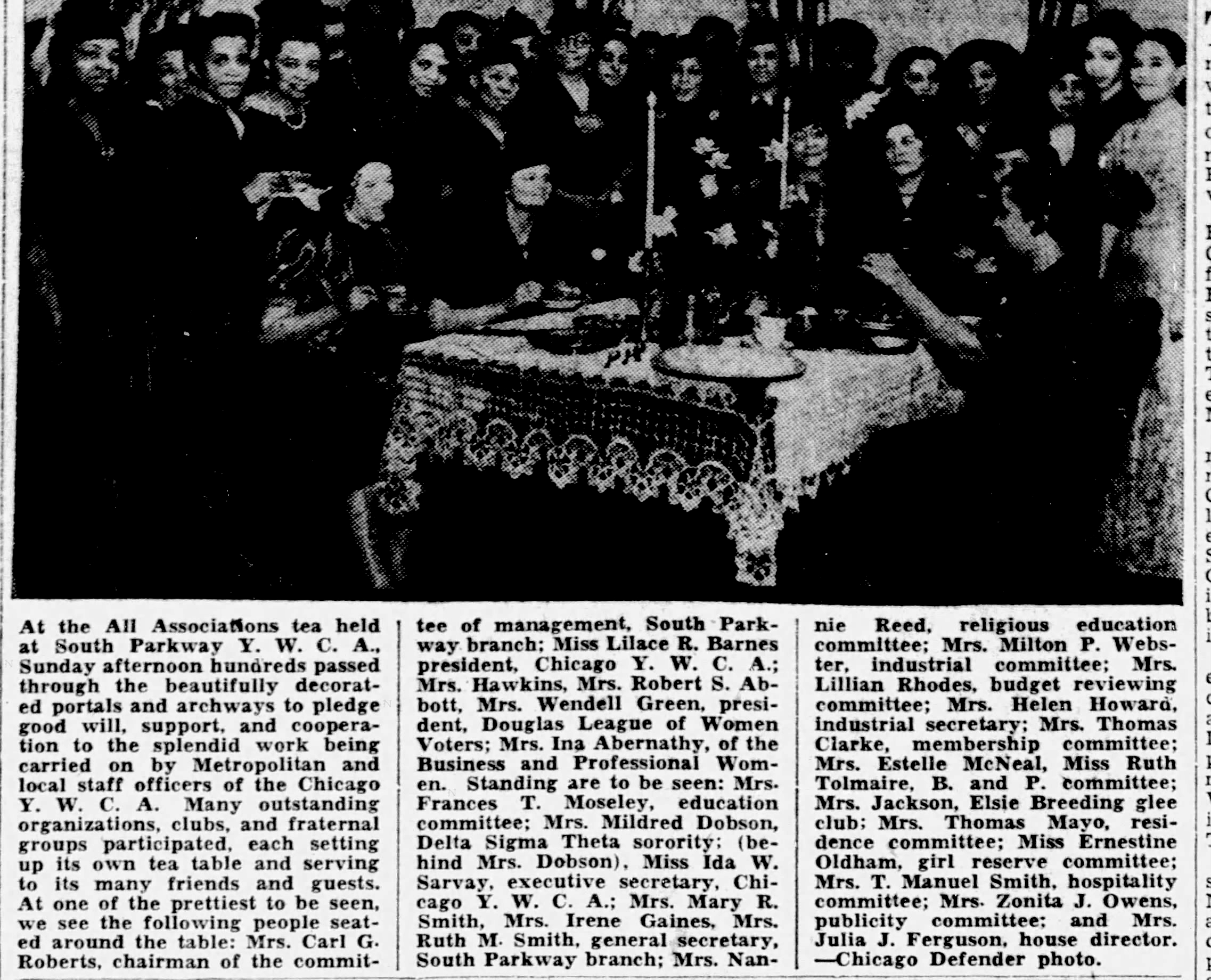
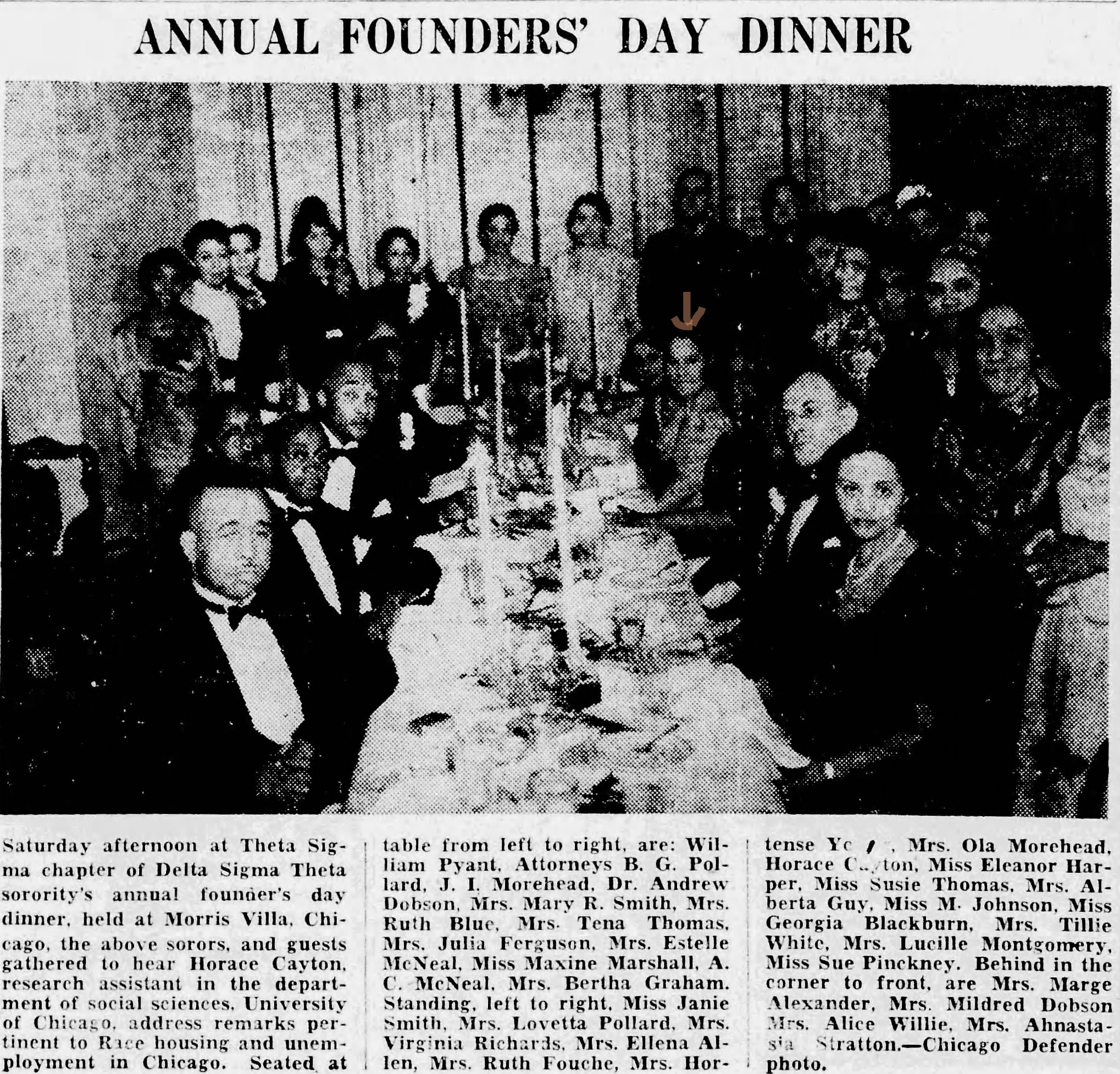
The impulse that sent Julia to the YMCA in the ashes of Greenwood never left her. In Chicago it became a career of community leadership. In 1938 she was the house director of the South Parkway YWCA, named in the Chicago Defender's coverage of its “All Associations” tea — a hub of Black women's civic organizing on the South Side. She moved in the same circles as Delta Sigma Theta sorority and the sociologists Horace Cayton and St. Clair Drake, whose landmark study of Black Chicago, Black Metropolis, grew out of that very world.
Her faith community was part of that same public life. In June 1938 the Chicago Defender listed “Mrs. Julia A Ferguson” among the officers and leaders responsible for the Annual Women's Day program at Olivet Baptist Church — one of the largest Black congregations in the country, and a cornerstone of South Side religious and civic life. Her membership and leadership there place her at the center of Black Chicago's institutional world.
Her service was also economic. In 1949 the Chicago Defender reported that Julia Ferguson had been elected vice-president of the Parkway Garden Credit Union, a cooperative serving the four hundred mutual-owner families of Parkway Garden Homes at 63rd and South Parkway. A generation after the destruction of Black Wall Street, she was helping to build Black cooperative wealth again — this time in Chicago.

Chicago Defender · Mar 26, 1949
Primary source“Parkway Garden Credit Union In Second Year of Operation” — “the following officers were elected: Louis W. James, president; Julia Ferguson, vice-president…”
View the clipping (PDF)Her life in the record
A documented life
- 1885Primary source
Born Julia Althea Ruffin on November 16 in Calvert, Robertson County, Texas, to Willie Ruffin and Laurina Gilmore.
- c. 1910sCommunity-verified
Marries Dr. Andrew C. Jackson and joins him in Tulsa's Greenwood district. Works as an educator in the Tulsa Public Schools.
- 1921Primary source
Survives the Tulsa Race Massacre. Dr. Jackson is murdered on their lawn on June 1. Three days later, the Tulsa Tribune names “Mrs. Julia Jackson” as taking charge of the Y.W.C.A. temporary relief house for homeless Black women and girls.
- 1923Primary source
Signs the Notice to Creditors for Dr. Jackson's estate as “Julia A. Ferguson-Jackson, Administratrix,” from 101 North Greenwood Street, Tulsa — by now remarried, but still settling his affairs.
- 1938Primary source
In Chicago, she is a founding supporter of the South Side Community Art Center, photographed by the Chicago Defender alongside the artist Eldzier Cortor; serves as house director of the South Parkway YWCA; and is named among the women's-day leaders of Olivet Baptist Church, where she was a member.
- 1939Primary source
Applies for a Social Security number in Chicago as Julia A. Ferguson, living at 4919 Washington Park Court.
- 1941Oral tradition
First Lady Eleanor Roosevelt dedicates the South Side Community Art Center on May 7 in a ceremony broadcast nationally. Family history holds that Julia, a central figure there, met her.
- 1949Primary source
Elected vice-president of the Parkway Garden Credit Union, a cooperative at 63rd and South Parkway.
- 1971Community-verified
Dies in Chicago on June 27, outliving Dr. Jackson by just over fifty years.
Primary source
Her own record, 1939
Half a century beyond the fire
Her long life, and her name
Julia lived on in Chicago for three decades after her SS-5 application, dying there on June 27, 1971 — outliving the husband she had begged to leave Tulsa by just over fifty years. She was eighty-five.
Earlier drafts of this registry recorded her later surname as “Lester.” The primary record is consistent and clear that the name was Ferguson: she signed the 1923 estate notice as “Julia A. Ferguson-Jackson,” the Chicago Defender named her as Julia Ferguson throughout the 1930s and 1940s, and her own 1939 SS-5 application reads “Julia A. Ferguson.” This page has been corrected accordingly. Research continues into her second marriage and her later life in Chicago.
Sources & research notes
- Julia Althea Ruffin Ferguson, Application for a Social Security Account Number (Form SS-5), signed August 5, 1939, Chicago — family collection (primary source for her date and place of birth, parents' names, and married name)
- Tulsa Daily Legal News, May 17, 1923 — Notice to Creditors, Estate of Andrew C. Jackson (No. 3797), signed “Julia A. Ferguson-Jackson, Administratrix,” 101 North Greenwood Street, Tulsa
- Tulsa Tribune, June 4, 1921, p. 6 — “Hostess House for Negroes Is Being Erected,” naming “Mrs. Julia Jackson” in charge of the Y.W.C.A. temporary relief quarters
- The Chicago Defender: “All Associations” YWCA tea (Jan. 15, 1938); Delta Sigma Theta Founders' Day Dinner (Jan. 29, 1938); Olivet Baptist Church Women's Day (June 18, 1938); “Artists Display Work at Exhibition” with Eldzier Cortor (Dec. 10, 1938); Parkway Garden Credit Union (Mar. 26, 1949)
- University of Chicago, “Mapping the Stacks” — South Side Community Art Center records (founding and May 1941 dedication)
- U.S. National Library of Medicine, “Remembering Dr. Andrew C. Jackson” (2021) — identifies Julia A. Jackson as a Tulsa Public Schools educator and preserves the family's account of her warning
- Mary E. Jones Parrish, Events of the Tulsa Disaster (1922) — survivor account documenting the Red Cross and YMCA relief headquarters
- Jackson family oral history — Julia's warning to Dr. Jackson and her acquaintance with Eleanor Roosevelt (her “helping at the Y” is now independently confirmed by the June 4, 1921 Tulsa Tribune)
Research status
Julia's vital details, her 1921 relief work, and her Chicago public life are established by primary sources (her SS-5, the Tulsa Tribune, the Tulsa estate notice, and named Chicago Defender coverage). One thread still rests on family oral history and is marked as such: her personal meeting with Eleanor Roosevelt. The documented facts around it are strong — Julia was central to the South Side Community Art Center in exactly the years Roosevelt dedicated it (May 7, 1941) — and the family continues to search for the newspaper article that records the meeting directly, as well as for records of her second marriage.